

Revised carbon emission factors: transparency driving sustainability


Delivering on Clariant's purpose »Greater chemistry - between people and planet.«
This story is an example of how Clariant delivers on its purpose-led strategy.
At Clariant, transparency regarding the carbon footprint of our products is key for the sustainability transformation of our portfolio. This transparency supports our shift to climate-neutral operations and low-emission raw materials, while also providing our customers with science-based information to make informed decisions and reach their own sustainability goals.
This is why Clariant launched in 2022 its automated product carbon footprint (PCF) calculator to provide customers with PCFs for their products. The CliMate tool uses primary operational data from Clariant sites, along with emission factors based on supplier data and industry average databases.
Yet, carbon emission pathways are far from static. As our understanding of climate change, economic activities, and data accuracy and availability evolve, so too must our methods of measuring and managing carbon footprints. The recent updates in the ecoinvent database—which is the base for many Life Cycle Assessments (LCAs)—include new data that impacts the carbon footprint calculations of fossil-based products, particularly for crude oil, natural gas, and their resulting products. Therefore, these latest changes in emission factors are now reflected in Clariant’s CliMate tool to provide the most up-to-date carbon footprint coverage of our portfolio to both our customers and internal decision-makers.
How have emission factors changed?
Ecoinvent's latest versions (3.9 and 3.10), introduce significant changes by incorporating new data on crude oil and natural gas supplies, including previously underestimated methane emissions from extraction and processing. These updates are based on the global supply situation in 2019 and expand the database’s coverage to include 90% of global crude oil production and nearly 80% of natural gas. Moreover, the updates enhance data for essential chemical precursors like ethylene oxide and short-chain alkenes, broadening the technological and geographical coverage across Europe, China, and the United States.
From cradle to grave: The effect on the chemical industry
As a result of the recent adjustments, ecoinvent's updated data sets indicate that products made from crude oil and natural gas have a significantly higher carbon footprint than previously estimated. For instance, the carbon footprint of commodity plastics has increased by approximately 30%, according to the Renewable Carbon Initiative. Also, the fossil footprint of naphtha has nearly doubled, affecting downstream processes such as ethylene oxide, ethylene glycol, and polyolefins production.
The results will impact the industry, as many organizations rely on ecoinvent as a secondary emission factor database. It is also likely that other recognized databases, such as Sphera (GaBi), will re-evaluate their data, leading to similar updates and effects. Additionally, the new data sets could help shape further the European regulatory landscape, where there is a renewed policy push for incentives on bio-based and circular products to support Green Deal objectives.
Looking specifically at the impact on Clariant, the emission factors for some fossil-based products that are relevant to our supply chain have markedly increased.
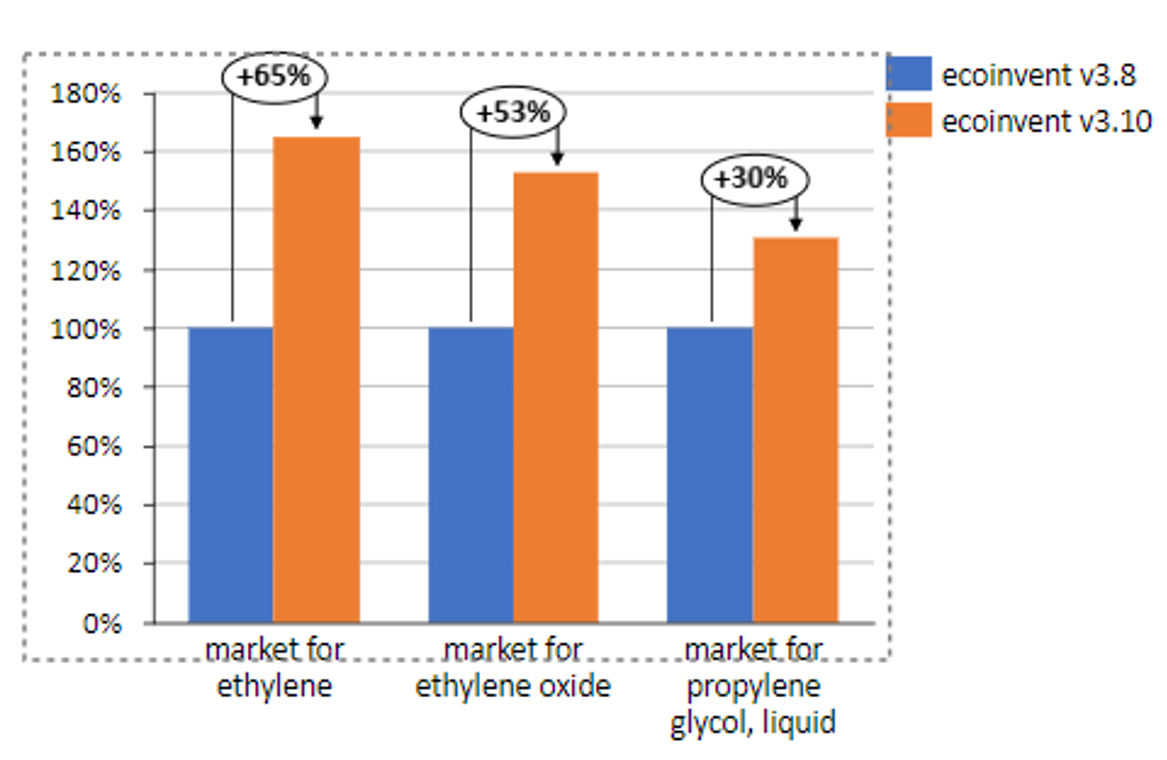
The emission factors for some fossil-based products in Clariant’s supply chain have markedly increased
Source: Own Graph based on ecoinvent v3.10 data.Emission factors are calculated based on the current level of accessible knowledge and predefined guidelines. Changes in the assessment scope, advancements in our understanding of environmental processes, modifications in production parameters, or adjustments to guidelines can directly impact emission factor calculations, causing fluctuations. For Clariant, adopting these new emission factors for raw materials as a front-runner could result in an increase in PCFs based on fossil raw materials, a trend expected across all value chain players.
An opportunity for sustainable solutions
By adopting ecoinvent’s recent adjustments to emission factors, especially for fossil-based raw materials, the difference in carbon footprints between fossil and non-fossil materials becomes more apparent. The new data highlights the significantly lower carbon footprint of bio-based polymers.
Collaborating for greater chemistry – between people and planet
Our commitment to sustainability is demonstrated by transparently providing our customers with PCFs that reflect the latest industry knowledge on greenhouse gas performance. Transparency and improved reliability are key benefits of using this data, helping to build mutual trust for long-term relationships. While it may result in higher PCFs, we anticipate that as the industry adopts the new data, PCFs will eventually align across the board. Regardless, we view incorporating the updated dataset as essential to meeting the requirements outlined in the Together for Sustainability (TfS) Guideline.
Therefore, these changes may drive our customers toward less carbon-intensive alternatives and strengthen the market for such products, addressing the growing consumer demand for sustainability information in their purchases. Through continued collaboration with our customers, we help foster greater chemistry and deliver solutions that support the transition to a climate-neutral economy.